One folder, fourteen files, each with a reader of its own.
When StackVet checks your app, it writes a folder named stackvet-report inside the app's folder. Start with report.html: it is the whole report on one page, and it ends with this same list.
| File | What it holds | Who it is for |
|---|---|---|
report.html | The whole report on one page: what to fix first, what was not examined, and every requirement that applies | You, in a browser: double-click it |
compliance.md | Every requirement that applies, chapter by chapter, with what is known of each; the threats; what only you can check; and the tests worth writing | Anyone who needs the whole picture against the standards, you or someone you show it to |
security.md | What the checks found, each in full (where, the code, how sure, why it matters, what to do, and how to set it aside), then what was not examined | Whoever fixes the code, you or your AI coding tool |
low-findings.md | Every low-severity finding in full, where the other reports group them by rule | You or your AI coding tool, when you want the detail |
before-going-live.md | What to do or confirm before the app is on the internet, in the order you would do it, with what could not be verified at its end. It credits nothing | You, or whoever puts the app on the internet |
fix-now.md | What needs attention, worst first, each with where it is and what to do: the findings of security.md that are things to fix | You or your AI coding tool, first |
your-decisions.md | The questions only you can answer and the checks only you can make, from compliance.md | You |
not-examined.md | What this report could not look at, and why, with the outside tools' runs, from compliance.md | You, before you read anything as safe |
information.md | What asks nothing of you: findings in test code, checks that found nothing, your AI coding tool's files, and the text of each requirement, from compliance.md and security.md | You, when you want the rest |
stackvet.sarif | The findings as SARIF, a standard format for findings (named findings.sarif before 14 October 2026) | Code editors and GitHub's code scanning, which show a finding beside its line |
report.json | The report's data as JSON | Programs, among them sv review, sv compare, and sv dashboard |
seen.json | What sv saw of the running app, with every key and sign-in in it cut short | You, to see what a finding rests on |
sbom.cdx.json | The app's bill of materials, every package it uses with its version, as CycloneDX JSON | Tools that read a bill of materials |
report.pdf | The whole report as one file to read, print, or send: compliance.md's order, with each finding in full. US Letter paper unless stackvet.toml's report-paper setting asks for A4; its fonts show Western European letters only, so report.html is the complete version | You, or whoever you hand it to |
`security.md` is what to fix. `compliance.md` is the whole picture.
On a small app the two open with the same lines: the app's name, when the report was made, and whether StackVet was used while the app was built. After that they part.
security.mdis for whoever fixes the code. Each thing to fix is set out in full: the file and line, the code itself, how sure StackVet is, why it matters, and what to do. Then it lists what was not examined, so nobody takes a short list of findings for a clean bill of health. Give it to your AI coding tool when you ask it to fix what was found.compliance.mdis for anyone who needs to see the app against the standards: every requirement that applies, chapter by chapter, with what is known of each, from needs attention to not verified. It also has what could go wrong with an app like yours, the questions only you can answer, and the tests worth writing. Open it before launch, or when someone asks how the app measures up.
Each opens with a line saying what it holds and who it is for.
An example of each
A real report, made by StackVet from one of its own example apps.
The example is Notes with users (examples/notes-with-users), a small notes app with accounts and an admin page, written for StackVet's own tests. Its report has two things to fix, one of them low severity, and requirements in several states: needs attention, checked, checked in part, not verified, and not assessed.
report.htmlcompliance.mdsecurity.mdlow-findings.mdbefore-going-live.mdfix-now.mdyour-decisions.mdnot-examined.mdinformation.mdstackvet.sarifreport.jsonseen.jsonsbom.cdx.jsonreport.pdf
- What it leaves out, and says so: it was made, as the first one of 14 October 2026 was, without starting the app (no
--run) and without the outside security tools (--no-tools). Soseen.jsonis nearly empty, nothing was asked of the running app, and the report's "What was not examined" says both. A report made with--runhas more in each file; this one shows what each file is, not everything StackVet can find. - How it was made, so it can be made again: from the repository's top folder, with
svbuilt from the commit the report names on its second line,sv report examples/notes-with-users --no-tools --out docs/website/reports/notes-with-users, on 22 November 2026 bysv0.3.0 (backlog 0698; first on 21 November by 0.2.0, backlog 0696), in place of the report of 14 October, whichsv0.1.0 made with 8 of these 14 files. The home page's example lines are taken from it. The health-tracking app built for a friend is never used as an example.
The standards StackVet checks against are not only for the end.
Building software goes round a cycle of six phases: planning, analysis, design, implementation, testing and integration, and maintenance, and then back to planning for the next change.
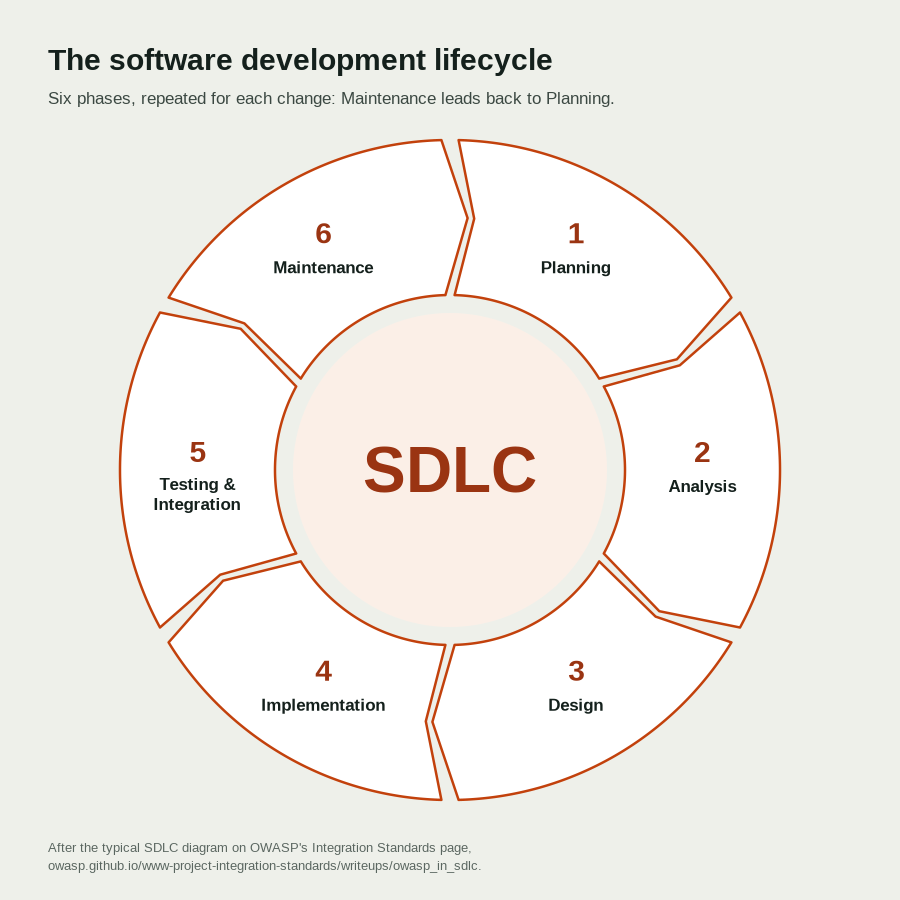
Each of the three standards in a StackVet report is chiefly for some of those phases, and reaches into others for part of its work. Secure by Design is decided before any code is written; ASVS is the list of requirements to build to and check against; AISVS is for apps that use AI, and its Appendix C for apps built with it.
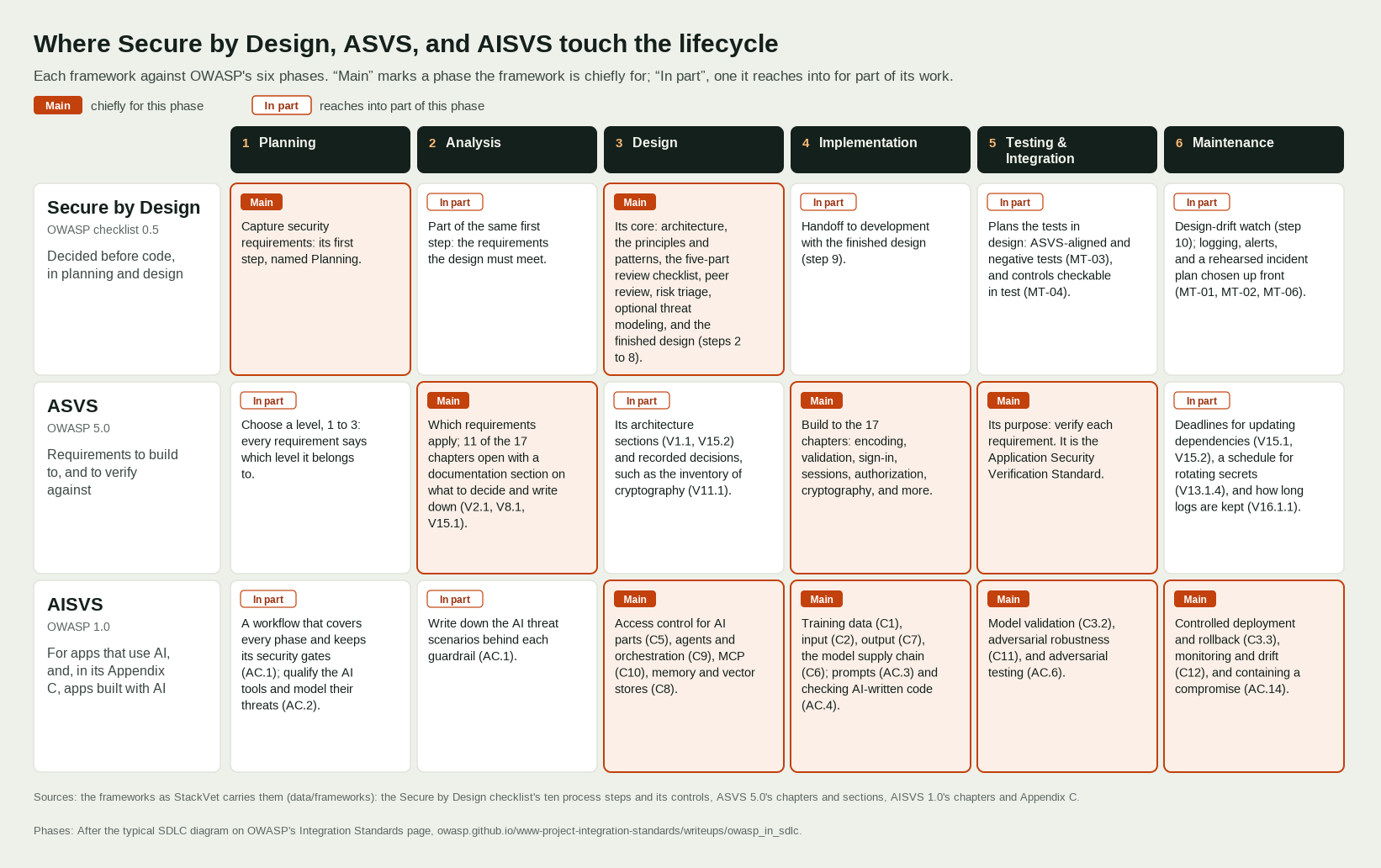
The owner drew both on 13 October 2026 (diagrams/source/make_diagrams.py). Each cell of the second was checked against the standards' own text as StackVet carries it (data/frameworks) on 15 October 2026, and six cells' words were corrected to say no more than the sections they cite; no cell's tag changed (backlog 0514).